A well designed guest suite in the basement does more than absorb overflow during the holidays. In Alexandria, it can be the most private and indulgent space in the home, a quiet retreat for visiting family, or a dignified place for a nanny or an aging parent. Done right, it carries the same level of detail you expect on the main floors, with the bonus of separation. Done poorly, it feels like a compromise. After years working in basements across North Virginia and the City of Alexandria, I have learned where luxury lives below grade, and what separates a cleverly planned suite from a pretty room that disappoints after the first stay.
Why Alexandria basements are their own species
Soils near the Potomac like to move with water. Many lots are tight, with shared driveways and mature trees you want to keep. Plenty of houses sit inside historic districts, which brings additional eyes on exterior changes. And older homes often come with fieldstone or brick foundations that deserve respect. You can achieve something beautiful and durable, but the playbook must account for moisture management, egress, and structural nuance before you sketch millwork or choose tile.
The local code baseline comes from the Virginia Uniform Statewide Building Code, which leans on the International Residential Code. This governs ceiling height, light, mechanical ventilation, emergency escape and rescue openings, smoke and carbon monoxide detectors, and stair geometry. In practice, a comfortable and compliant guest suite in a basement needs at least one code compliant egress window or exterior door out of the sleeping area, a bathroom with proper ventilation, and ceilings that are generally 7 feet or higher in habitable spaces. Most beam and duct drops can be lower for a short run, but a continuous 7 foot feeling keeps the space calm rather than cramped. You also need to coordinate with Alexandria permit staff for window well approvals, especially on tight lots or when altering façades that are visible from the street.
Start with the envelope, not the furniture
Every luxury decision inside the room sits on a foundation of dryness, warmth, and quiet. Skip those, and a stone niche or a slab of veined marble will not save the experience. The correct sequencing matters. We assess exterior drainage, downspout extensions, grading away from the foundation, and whether an interior perimeter drain and sump is warranted. In houses near the water table, a redundant pump with battery backup is not an extravagance, it is insurance for your floors and millwork.
On walls, I prefer continuous rigid foam insulation against the foundation, seams sealed, then a framed wall with mineral wool for sound and thermal performance, and a smart vapor retarder where the assembly wants it. This gives you a comfortable surface temperature, which defeats the clammy feeling guests remember for the wrong reasons. Below the feet, a vapor barrier over the slab, then an insulated subfloor where ceiling height allows, changes everything. People do not notice an R value, but they do notice when their toes are not cold in January.
For flooring, better choices in a basement include porcelain tile with radiant heat, or high quality luxury vinyl plank that can shrug off a small incident. I have installed 7.5 inch European home remodeling contractor in Alexandria VA oak in basements where we had perfect drainage, robust dehumidification, and a homeowner who accepted the long term care required. If you love real wood, we can design around it, but it calls for a very explicit moisture management plan.
Light that flatters, not fights
Natural light is currency in a basement. When code requires an egress window, we look for landscape strategies that make the well feel like a garden, not a pit. Stone liners, integrated drainage, and a steel grate that holds planters instead of a raw cover raise the mood. Inside, put the bed wall where indirect light reaches, so guests wake to a gentle wash, not a glare at eye level.
Artificial lighting is where luxury shows restraint. A low ceiling needs layers: small aperture recessed cans on dimmers for general glow, wall washers to calm the perimeter, and a pair of statement fixtures to bring warmth and scale. I favor warm 2700 K or 3000 K color temperature for guest suites. Avoid over-lighting bathrooms with harsh downlights over the mirror, which cast unflattering shadows. Edge lit mirrors or vertical sconces at eye level make a world of difference when a guest is preparing for an event in Old Town.
Silence is luxury
Sound control in a basement is not only about the suite itself, it is about the household above. No one wants to hear early risers on hardwoods or a dog racing for the back door. Resilient channels on the ceiling with 5/8 inch drywall, mineral wool in the joists, and a thoughtful approach to duct penetrations keep voices and footfall at bay. Solid core doors with proper weatherstripping help as much as any decorative flourish. In one brick rowhouse off King Street, we combined these measures with a dense wool carpet runner upstairs. The result felt like a boutique hotel downstairs, even on busy mornings.
The ensuite bathroom carries the show
Good basement remodeling always includes a strong bathroom. Guests notice the temperature of the floor, the pressure of the shower, the way the mirror lights their face, and how fresh the air is after a long shower. If you ever hosted a bridal party, you know what I mean.
Curbless showers bring a spa feel and remove trip hazards. They require careful planning for slope and drain location, especially when we do not want to trench the slab. We often use a pre sloped shower pan and an offset drain to avoid cutting into structural beams, then continue the same tile outside the shower to visually enlarge the room. Large format porcelain makes maintenance painless, while a feature wall in marble or a porcelain marble look gives the upscale note without inviting stains.
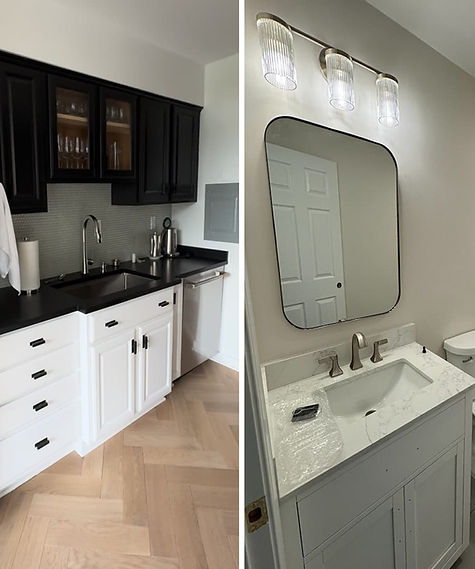
Ventilation needs to be quiet and effective. I specify a fan rated for higher humidity and slightly oversize it, then set it on a timer control. Duct it to an exterior wall with minimal bends. Vanity choices follow the layout. If you want more air, float the vanity so floor tile runs clear under it. Choose a single slab counter with an under mount sink and a tall widespread faucet that charms the hand, not a builder grade chrome that splashes.
Heated floors make a basement bathroom feel civilized in winter. It is a modest power draw when zoned correctly and gives guests the kind of comfort memory that they share.
Kitchenette that earns its keep
Not every guest suite needs a full kitchen, but a discreet kitchenette stops early morning traffic on the stairs. I like a 24 inch panel ready refrigerator, an under counter microwave or speed oven, a small induction cooktop with a concealed vent option when code and layout allow, and a deep sink that can hide a French press carafe. Quartz counters are perfect here, and a hand glazed tile backsplash brings soul at a small square footage.

This is where a kitchen remodeling perspective helps in a tight footprint. We use tall uppers for glassware and plates, a pull out pantry for snacks, a trash roll out, and under cabinet lighting that doubles as a night light. On one project in Del Ray, we built a pocket bar in walnut between a closet and bath wall. The client stocked it with local gin, and the visiting parents never had to navigate the main kitchen at midnight.
Layout: treat the suite as a small apartment
A great basement suite respects privacy lines and sight lines. The bed should not stare at the bathroom door. If there is a window, the bed should catch a sliver of it. Place the sitting area by the light source, then back it with shelving or a low console so the room reads as layered rather than a box with furniture around the edges.
Stairs matter. Add a window at the landing if you can. Change the tread and riser finish so the descent signals a different mood. A pocket or barn door at the base of the stairs gives privacy when needed, but keep swing doors generous for ease of moving luggage and laundry. I prefer a 36 inch door for the suite entry, with a lever handle that is friendly to arthritic hands.
Storage is dignity. Give your guests a real closet with a proper rod and shelf, a luggage bench, and a few empty drawers. Compartmentalized storage for extra linens, iron, and cleaning kit means they do not have to knock and ask. Built ins, if you have the length, can hold a television that disappears behind doors, a small library, and concealed speakers.
Mechanical comfort and air quality
Tie into the main HVAC only when the distribution can actually do the job. In many Alexandria homes, the original ducting was never designed to serve conditioned space below grade. A ducted mini split system or a compact air handler dedicated to the lower level gives you precision without starving the upstairs. Aim for quiet, variable speed equipment. Put a supply near the bed and one near the sitting area, and always add a return at the far end of the suite.
Fresh air is the unsung upgrade. An energy recovery ventilator that brings tempered air into the basement dilutes moisture and stale odors. Pair it with a smart dehumidifier that drains to the sump or a dedicated line. Keep indoor relative humidity around 40 to 50 percent year round. Guests notice how a room smells within three seconds of opening a door, and a basement without fresh air smells like a basement, no matter how expensive the rug.
Egress done beautifully
The code requires an emergency escape and rescue opening for bedrooms, often achieved with an egress window. The net clear opening typically needs to be at least 5.7 square feet, the sill no more than 44 inches above the floor, and window wells deeper than 44 inches must include a ladder. That list sounds clinical, but in practice we make egress a design opportunity.
A steel or composite window well with stone cladding, integrated drainage, and a clear cover can feel like an intentional light court. We have built wells with cedar slats and low voltage lighting that throw a soft glow in the evening and prevent the slightly subterranean feeling that many basements suffer. When historic review limits visible exterior changes, we coordinate the window placement to rear or side elevations and use landscaping to soften the impact.
Materials that age with grace
Below grade environments reward materials that do not flinch at humidity swings. Solid wood doors, lacquered or oiled, feel right in the hand. Painted MDF holds up if well sealed, but keep it away from wet floors. Use stone thresholds at bathroom transitions. Choose porcelain that mimics limestone rather than soft limestone that etches with a miniature toothpaste spill. For fabrics, performance velvets and tightly woven wools bring softness that resists spills.
Color is personal, but basements love warm neutrals with a note of saturation in one corner. Think bone on the main walls, a gray green on millwork, and a caramel leather on the bench. Metals should coordinate, not match. Aged brass on hardware and polished nickel in the bath look collected rather than boxed set.
Accessibility and future proofing
An elegant guest suite today can become a caregiver’s quarters or a respite space after a surgery. Soft landings make life easier for everyone. A curbless shower with a linear drain, blocking in the walls for a future grab bar, a shower bench that looks like a spa detail but serves a functional purpose, lever handles instead of knobs, and clearances that allow a walker to turn all fit naturally into a luxury design. If the budget allows, a pocket door with soft close hardware on the bathroom beats a narrow swing every time.
Laundry access is another long term win. A compact washer and dryer behind cabinet doors keep the suite self sufficient for a long stay. Run a second water shutoff accessible from a closet, and label it. Future you will be grateful.
Costs, timelines, and where to invest
For a high caliber basement remodeling that creates a complete guest suite in Alexandria, recent projects have ranged from about $175 to $350 per square foot, depending on structural work, drainage, and finish level. Egress windows, exterior stair rebuilds, and complex HVAC can push to the upper end. If you want stone slab walls, a steam shower, custom millwork across an entire wall, and a dedicated mechanical system, expect to be near or above that band.
Permitting in the City of Alexandria typically adds several weeks for review. If the home is in a historic district and you are altering a visible façade, plan on additional review time. Good home remodeling contractor teams factor this into the schedule and keep demolition and loud work respectful of neighbors. Many of our clients want the suite completed before a family event. Work backward, and pad your timeline. Eight to sixteen weeks is a realistic build window once permits are in hand, longer if significant structural or water management work is required.
Spend on the envelope first, then the bathroom, then sound control, then millwork. Decorative lighting and hardware come next. You can upgrade soft goods later, but you cannot retrofit a bad floor assembly without pain.
Working with the right partner
Basements are not where you want a learning curve. An experienced home remodeling contractor who has solved Alexandria basements across different eras of construction will anticipate existing conditions and communicate trade offs early. Ask to see drain details, insulation assemblies, and sound control drawings, not just pretty renderings. If you plan other projects, like kitchen remodeling or home additions, it pays to think holistically. A basement suite can be the first phase of whole home renovations, with mechanical systems sized for the final vision. Running a gas line or electrical subpanel during the basement phase may save walls and money when you touch the kitchen later.
If you are interviewing firms, pay attention to how they talk about moisture, air, and light. Watch for a team that starts with drainage and code, then moves to aesthetics, not the other way around. The same group that obsesses over a tile layout usually cares about flashing details. That is who you want underground.

Real world examples
A brick Colonial near Rosemont had a half finished basement with paneling fixed tight to the foundation and a bathroom that felt like a cabin. The owners wanted a serene suite for grandparents who visited for several months at a time. We re graded a swale at the side yard, added downspout extensions, and installed an interior drain to a sealed sump with a battery backup. The walls received two inches of rigid foam, then a 2 by 4 wall with mineral wool. Ceilings topped out at 6 feet 10 inches under a beam, so we adjusted the furniture plan to keep standing zones at full height. The bath went curbless, with a porcelain slab feature wall and radiant heat. A ducted mini split served the suite, and an ERV kept the air fresh. The result reads like a quiet annex to the home, not a basement. More telling, the grandparents extended their stay by a month.
In a townhome off Duke Street, space for an egress window was limited by utilities and setbacks. We carved a well that doubled as a planted light court, lined with charred cedar slats and uplighting. Inside, the bed wall received upholstered panels that turned the low ceiling into an intimate canopy. A pocket kitchenette fit within 7 linear feet, with a concealed speed oven and panel ready fridge. A built in banquette by the window became the morning coffee spot. This project showed how tight footprints can still feel rich when the details work hard.
Technology that disappears
Smart locks on the suite door ease guest arrival. Concealed ceiling speakers fed by a small amp give background music without visible clutter. A mesh Wi Fi node ensures strong signal underground. Motion sensors for night lighting along the baseboards are both safety and grace. A dedicated thermostat for the suite empowers guests and prevents climate battles.
We always plan for serviceability. Access panels are hidden in millwork, plumbing shutoffs live behind a magnetized panel in the closet, and an electrician can reach junctions without cutting the ceiling. The more complex your suite, the more vital it is to make it maintainable.
A short checklist before you commit
- Confirm water management strategy, including grading, downspouts, and any need for interior drains and sump Verify egress path and window well feasibility with Alexandria permitting early Test ceiling heights across the suite and map duct and beam drops to align with furniture zones Decide on HVAC strategy, either tie in with enhancements or dedicate a quiet mini split system Stage selections in order of permanence, from envelope and bath to millwork and fixtures, then soft goods
Guest comfort upgrades that make a difference
- Radiant heat in the bathroom and, if height allows, in the main suite floor Curbless shower with a bench, handheld plus rain head, and excellent lighting at the mirror A kitchenette with a quiet fridge, filtered water, and concealed trash Sound isolation measures at the ceiling, walls, and door seals Blackout treatments layered with sheers, and bedside controls that actually turn everything off
When a basement suite is not the answer
A frank word: sometimes an above grade addition wins. If your basement sits perpetually damp even after interventions, if ceiling heights drop below 7 feet throughout, or if your lot and historic status make proper egress impossible, we explore home additions to accommodate guests without compromise. The costs may be higher, but the joy per square foot also climbs. Other times, whole home renovations can reallocate space on the main level to create a flexible suite. A seasoned team will tell you when the basement is the right canvas, and when to look elsewhere.
Final thoughts from the field
Luxury below grade is the art of removing obstacles your guest never sees. No chill underfoot, no hum from a rushed duct, no mystery switch that does nothing, no trace of last week’s rain. What remains is ease. The door swings clear. The bed wall catches soft light. The bathroom flatters at 6 a.m. The small kitchen saves a trip upstairs. In a city like Alexandria, where history and humidity share the same map, that ease is the real mark of a thoughtful remodel.
Choose materials that forgive, systems that breathe, and a layout that respects how guests move through a day. Work with a home remodeling contractor who shows you the bones before the jewelry. Whether your basement suite serves a weekend or a season, it should feel inevitable, like it was always part of the house, waiting to be discovered.
VALE CONSTRUCTION
6020 Alexander Ave, Alexandria, VA 22310, United States
+17039325893
https://www.youtube.com/@valeconstructionva
https://www.facebook.com/valeconstructionva/
https://www.instagram.com/valeconstructionva/
https://www.linkedin.com/company/vale-construction-va/
https://x.com/valeconstruct
https://www.pinterest.com/valeconstructionva/